
Why Is Mullu Murukku Saltier?
Murukku is a crispy deep-fried snack that is popular across many Indian states, each of which has its own local version. The name ‘murukku’ in Tamil, or ‘chakli/chakri’ in Hindi, comes from its shape since it is usually made in the shape of a spiral or in twisted coils. (The verb ‘murukku’ in Tamil means ‘to twist’). The dough is made typically with rice flour, urad dal (or chickpea) flour and water, with salt and spices added for taste. The dough is then hand-formed or extruded into a desired shape and deep-fried in hot oil until crisp. Murukku is an excellent jar snack that keeps well for a few weeks and is quick to make. No wonder it is a popular festive or holiday treat in many Indian homes, and surely in mine 🙂
I recently made two kinds of murukku with the same dough, using two different ‘dies’ for extrusion. To my surprise, the two shapes tasted very different though the dough was exactly the same!! Intrigued, I searched around and went into this fascinating rabbit hole of how the shape of food affects our perception of its taste…
Typical murukku ‘dies’
My brass murukku-maker looks like this:
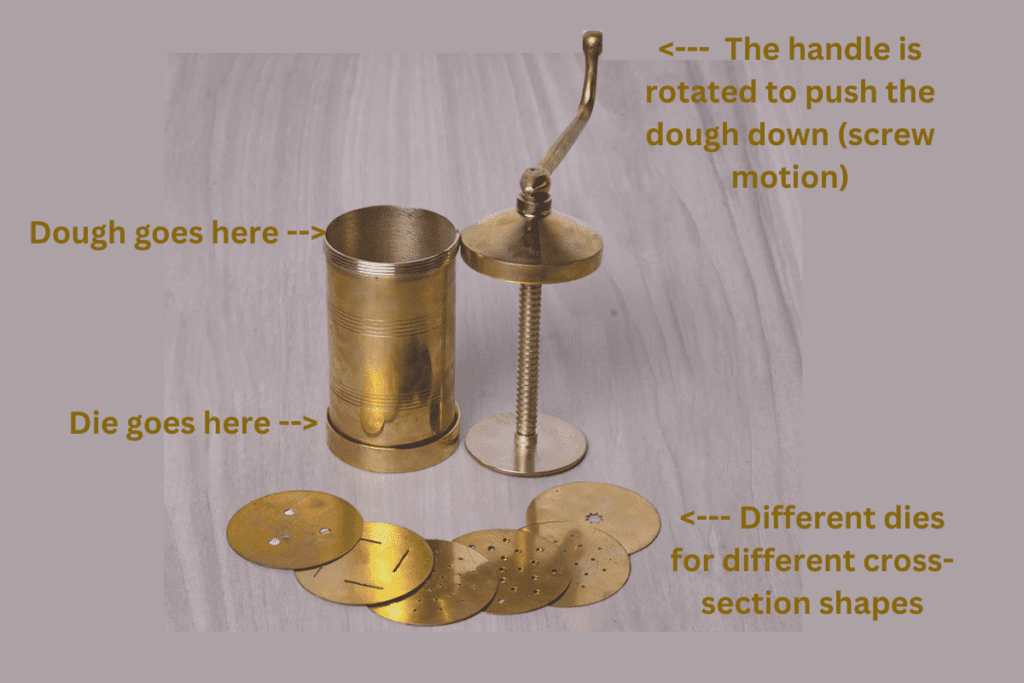
It comes with a set of varied dies, out of which only the round- and star-shaped dies (leftmost and rightmost in the picture, respectively) are used to make murukkus. The rest of the shapes are used for other snacks like sev, ribbon-pakoda, idiyappam, etc.
My round and star dies that came with my murukku maker were too big for our liking. The murukkus made with them came out dense and heavy and took a long time to crisp up. So I recently designed my own dies and laser-cut them on acrylic (in the Paper Crane Lab‘s studio. Check them out, if you are in Bangalore and like making things by yourself!). Here are the original brass dies that came with my murukku maker, side-by-side with the acrylic ones I made:
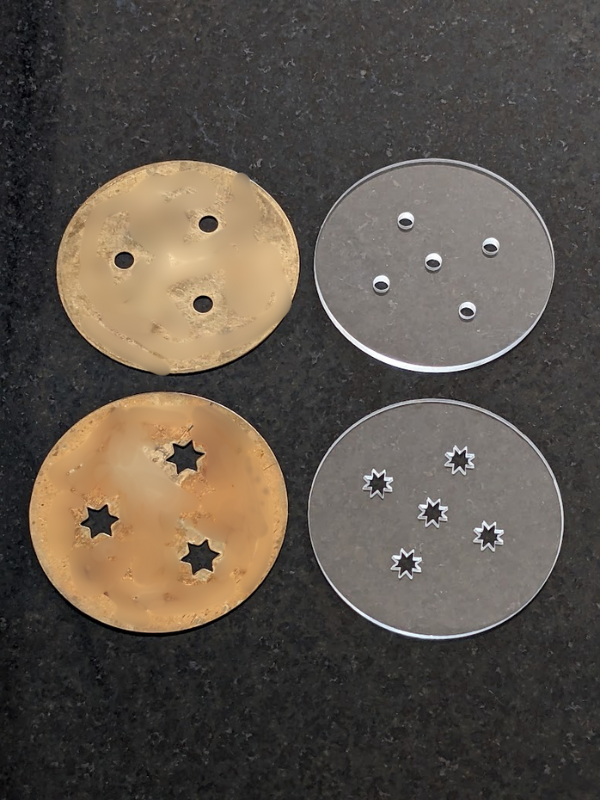
I wanted to test these new dies, hence the murukku experiment began 🙂
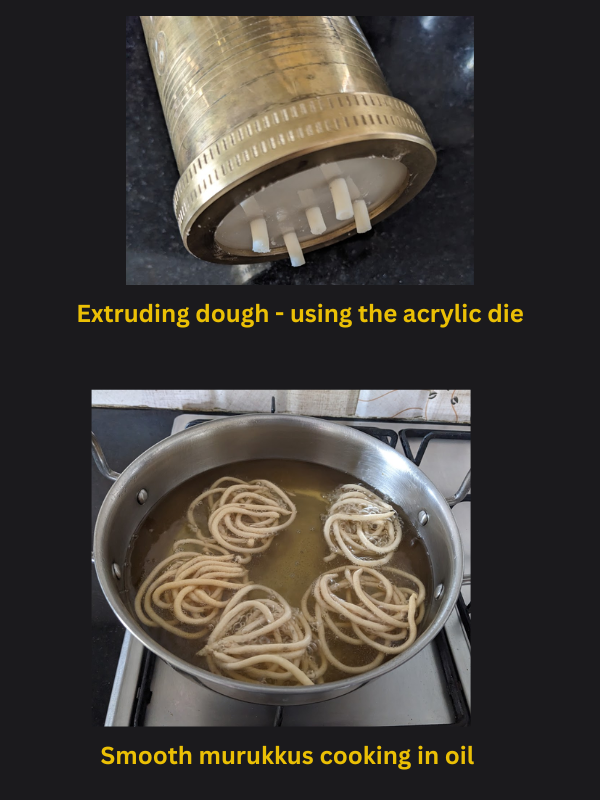
Here is how the murukkus turned out (recipe given below) with the acrylic dies:

Difference in taste
The murukkus were crunchy and delicious! But there was an immediately perceptible difference between the two shapes.. the mullu murukkus tasted much saltier than the smooth murukkus. They also felt more crunchy.
I could intuitively understand why the mullu murukku would feel more crunchy, since it had sharper edges (‘mullu’ in Tamil means ‘thorn’) due to the sharp points from the star’s corners. Also, comparing the cross section of the murukkus, the surface area of the star is much larger than that of the circle. So, a larger proportion of the star murukku’s dough would have been exposed to hot oil and hence this too might have contributed to the crunchier effect.
But its saltier taste left me perplexed. How could this be, when both of them were made from the same dough and were cooked roughly for the same time, in the same medium?? I dug out my Food Science books and dove straight into Nik Sharma’s The Flavor Equation since I faintly recalled reading about his case study on shape-flavor interactions.
How Shape affects Taste
Inspired by the work of experimental psychologist Charles Spence, Nik ran an informal poll, asking people which tastes they associated with different colours and shapes. Here’s what his survey threw up:

Nik surmises that sharp edges trigger a fear response, since our brain correlates them with signals for threat and danger (think broken glass or serrated knife). Due to similar evolutionary reasons, people have also learned to associate certain shapes with certain tastes over time. His explanation for why 46% of respondents in his survey associated a ‘Triangle’ with ‘Salty’, was that people relate sharper edge forms like triangles to the sharp edges in salt crystals.
Maybe that was why I (and everyone else at home) felt that the mullu murukkus were saltier. Further, it looks like people associate curved shapes with sweetness! And this might have affected how we perceived the taste of the smooth murukku, adding even more contrast between the two shapes!
But the size of Nik’s survey wasn’t clear, and I wanted to know whether the link between shape and taste is more scientifically established. So I searched around for a deeper explanation and came across some fascinating examples and work done in this area.
The Curious Case of the Circular Chocolate
In a popular example for how shapes have affected tastes widely, in 2013 in the UK, Cadbury introduced a chocolate bar with circular edges instead of their classic rectangular bars, while the recipe was unchanged. But customers were infuriated, thinking that the new circular bars were too sweet because the manufacturer had added more sugar to the recipe! (The company declared that the formulation was unchanged).

This curious sensation is explained by Professor Charles Spence, who heads the Crossmodal Research Laboratory at the University of Oxford. He and his colleagues have studied how our different senses interact to impact our overall perception of taste and flavour. He along with Massimiliano Zampini received the 2008 Ig Nobel prize for discovering the phenomenon he calls ‘sonic crisp‘ – whereby, the pitch and volume of the noise made when you bite into a potato chip impacts how fresh you think the chips are! This idea—that if you change the input in one sensory realm, you can influence perception in another—is called crossmodal sensory interaction, and it lies at the core of Spence’s research.
Shape Symbolism
It all apparently has to do with ‘shape symbolism’ as applied in food. That is, we subconsciously associate certain tastes with certain shapes. So much so that the shape, look and feel of a dish can ‘prime’ our brain to setup its expectations for a particular taste. And if this ‘expected taste’ matches with some of the attributes that are already there in the food (eg., salty, in the case of the murukku), then it reinforces or enhances that particular taste (in this case, making it feel saltier).
But if there is a mismatch (say, a sharp/angular food that feels like a potato chip but in actual tastes very different, say sweet), then the brain thinks that there is a disconnect and gets confused or upset!
A fun test you can try
In his book Gastrophysics, Charles Spence offers this playful scale along which you can place different foods based on where you think they best fit:
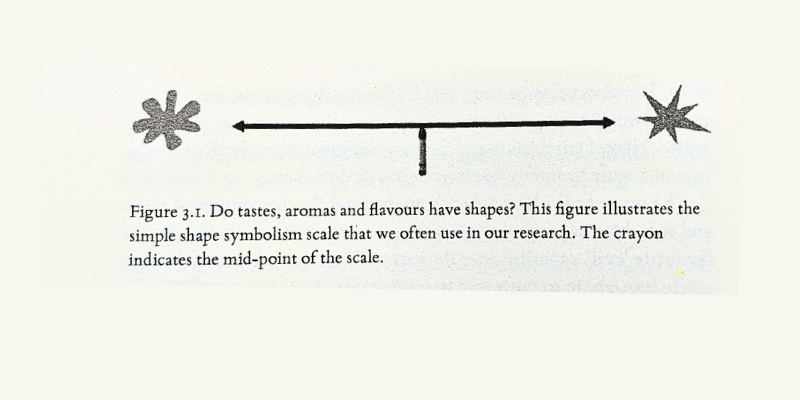
Now, try placing the following things on the above scale, one by one, according to your own judgement for where they fit best:
- dark chocolate
- cheese
- lemon soda
- milk chocolate
- cream
- water
- bouba
- kiki
(For the last two, don’t worry about what these words mean. Just try and place them). Read further only after you’re done with the list.
Here’s how most people place these items: The first three items are typically towards the right and the next three towards the left. The placement of the items goes further and further right as things get sharper, bitter, acidic. And further and further left when they are sweeter, creamier and softer. So, how similar or different was your placement??
Before you ask, ‘bouba’ mostly belongs to the left and ‘kiki’ to the right, in common perception. See how for even random sounds like these we associate certain shapes? Many brands use this kind of association to build a subliminal perception in our brains. Not just through the colour and shape of the food itself, but also through an evocative name for the product (eg., Crax), the logo design (eg., rounded logos for sweet carbonated drinks but sharp angular logos for acidic drinks like beer), the shape and colour of the packaging, etc. These cues subtly ‘prime’ our brains to anticipate a specific taste even before we even look or touch the actual product. And this all then gets reinforced when we consume the product itself… Crazy, isn’t it??
P.S: Recipe for the murukku
Rice flour – 3 cups, finely ground
Urad dal – 1 cup, roasted until slightly brown and ground into a fine powder
Salt – 1.5 tsp
Cumin seeds – 1.5 tsp
Hot oil or butter – 2 tsp
Water – about 2 cups
Oil – for frying
Mix the dry ingredients and the oil/butter in a large and wide bowl until they form the consistency of bread crumbs. When you press a handful of the mixture together, they should hold up but crumble easily when poked. Add water, reserving the last 1/4 cup. Mix well until the dough comes together into a ball. Add the remaining water little by little until the surface of the dough is smooth and without cracks. The dough should feel slightly wet to the touch, but firm. Heat up oil in a deep frying pan until it is almost smoking. Add a ball of dough to your murukku press and form your desired shape onto the flat part of your dosa turner (oil it slightly, before). Gently release the extruded dough into hot oil. Repeat until you have enough murukkus covering the surface of the oil but not overcrowding it. Turn them every 30 seconds or so and fry until the bubbles die down and the murukkus turn golden brown. Drain into a colander or on a plate lined with paper towels until cool. Serve immediately or transfer to an airtight box to store.